
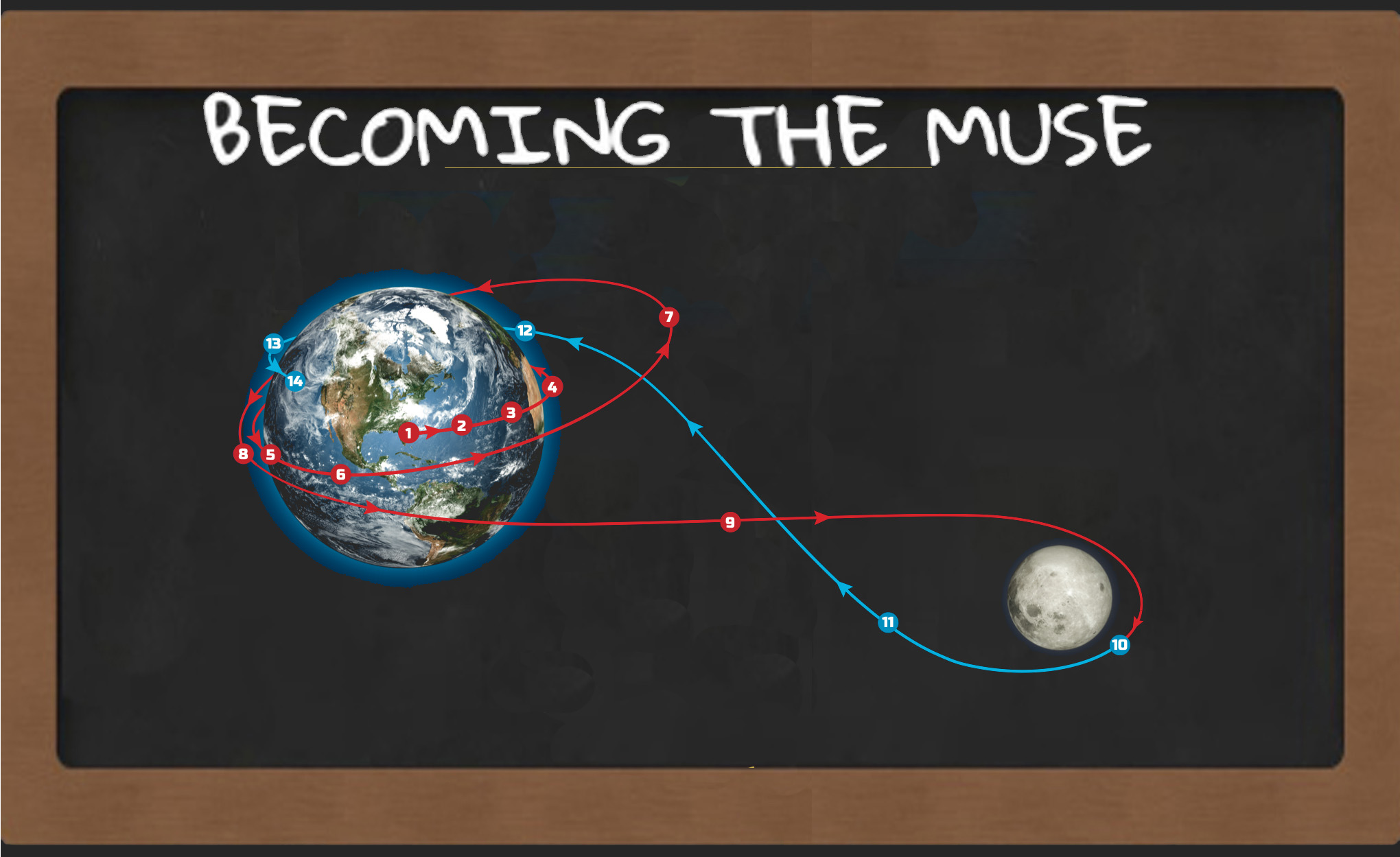
Artemis II Flight Path: Free Return Trajectory
NASA’s Artemis II crew is currently on a ten-day mission around the Moon, using a gravity-assist manoeuvre to slingshot past the moon and return back to Earth.

After launch, Artemis II will then orbit Earth twice to ensure Orion’s systems are working as expected while still close to home.
Orion’s main engine then performs a translunar injection burn, lasting just under six minutes, accelerating the spacecraft to break free from Earth’s gravity and setting course for the moon along a path dictated by the combined gravitational fields of Earth and Moon.
At roughly 6,400–9,600 kilometres above the Moon, Orion swings around the far side. The Moon, bends the spacecraft’s trajectory, redirecting it back toward Earth, like a stone curving around a bend in spacetime.

After the lunar flyby slingshot, Orion now heads home without needing major propulsion. They will parachute into the Pacific Ocean, completing the mission much, like Apollo astronauts did decades ago.
The concept seems simple, flyby the moon and slingshot back, but the execution is not, requiring multi-body gravitational modelling, calculation, monitoring and corrections. A small error early in the trajectory could mean missing the Moon or missing Earth entirely on return.

The “free-return” design, means that even if engines fail, the spacecraft will naturally loop around the Moon and head back to Earth. Apollo missions like the Apollo 8 and Apollo 13, have relied on similar free-return paths for safety under both routine and crisis conditions.

Artemis II follows a path carved before, but with the refinement that comes from more precise navigation systems, advanced computing and real-time correction capabilities.
It is the same dance, but with far better choreography.


Leave a Reply to BookstoogeCancel reply